
The Authenticity Alignment Audit
A fifteen-minute diagnostic for figuring out where you're actually operating from — and whether it's costing you more than it should.

If you’ve read the Dismantling Authenticity series so far (Prologue and Part 1), you’ll know the argument by now: there’s no fixed “real you” hiding underneath your adaptations, waiting to be excavated. There’s just alignment — the ongoing, active work of bringing your behaviour into relationship with your values, context by context.
Which is a satisfying thing to believe on a Tuesday afternoon when nothing's going wrong. It's considerably less useful on the Tuesday afternoon when something is going wrong, and you can't quite tell whether you're masking, adapting, thriving, or quietly running on empty — because from the inside, those four states can feel almost identical.
Part of why they’re so hard to tell apart is that “alignment” is actually doing two jobs at once, and most of us only ever notice one of them. There’s who you want to be in a given room — the values question. And there’s who you can actually be in that room right now — the capacity question, the bio-psycho-social reality of what you have available to spend today. A values-aligned adaptation you don’t have the bandwidth for isn’t a failure of authenticity. It’s just currently unaffordable. But it feels exactly like drift from the inside, which is precisely what makes it so disorienting.
That’s what this tool is for: separating the two questions so you can actually see which one is doing the damage.
What it actually measures
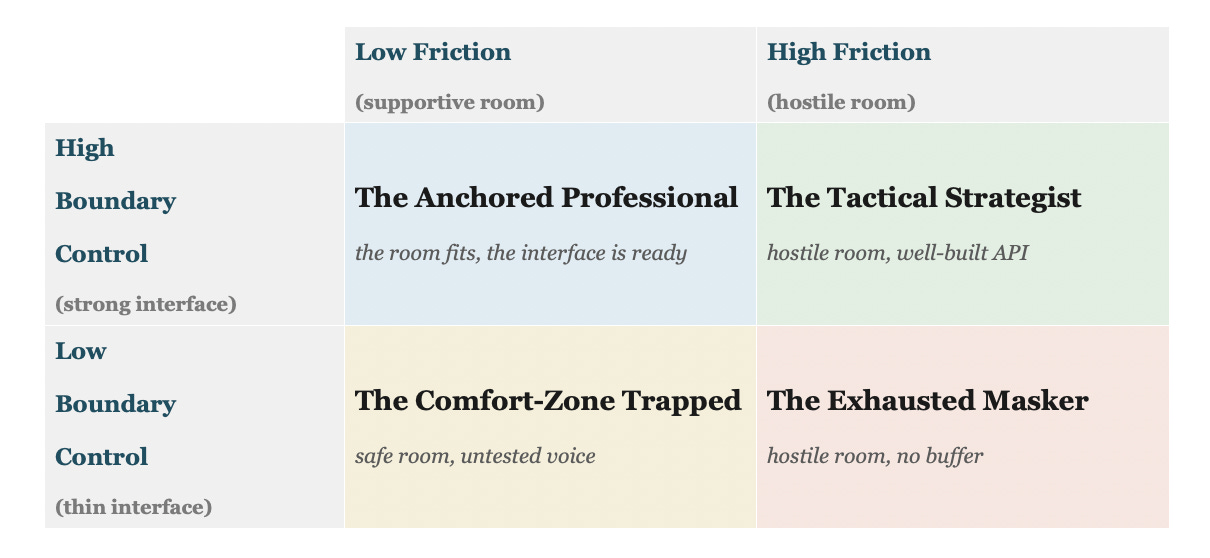
The Audit maps you across two axes.
Environmental Friction — how much the room you’re operating in is working against your natural processing style. Some rooms are genuinely difficult: rigid norms, low tolerance for difference, communication styles that don’t match how you think. Others are easier than they feel, because friction and discomfort aren’t always the same thing.
Strategic Boundary Control — how solid your interface actually is. Not how confident you feel, but whether you have real, usable structures: the ability to say no to low-value demands, the scripts and frameworks that let your ideas travel without you having to perform a different personality to deliver them.
Cross those two axes and you get four profiles — from the Exhausted Masker (high friction, low boundary control — the state the whole series exists to help you leave) through to the Anchored Professional (low friction, high boundary control — the rare, enviable spot where you’re spending very little energy on friction and have the structures ready for when it returns).
The layer that changes everything
Here’s the part that makes the Audit more than a personality quiz: sitting underneath the grid is a third measure, Values Clarity, and it doesn’t add a third axis so much as it reinterprets the other two.
The same position on the grid can mean two completely different things depending on your Values Clarity score. High clarity, and a polished, adaptive professional interface is exactly what it looks like — genuine alignment, tactical legibility, the real thing. Low clarity, and that same polished interface might just be masking with better production values: adaptation with no anchor, drift dressed up as competence.
In other words, the Audit doesn’t just tell you where you are. It tells you whether where you are is actually yours — a distinction that’s easy to lose sight of when the adaptation itself has gotten very, very good.
How to use it
Fifteen minutes, four sections, no scoring system that requires a spreadsheet. You’ll come away with:
Your position on the Friction × Boundary Control grid, and what that profile actually means day to day
A read on your Values Clarity, and how it changes the story your grid position is telling
A specific, profile-matched next step — not generic advice, but the thing that’s actually relevant to your particular combination of room and interface
The full Audit is below as a downloadable PDF.
Now go find out which quadrant you’re actually in.
